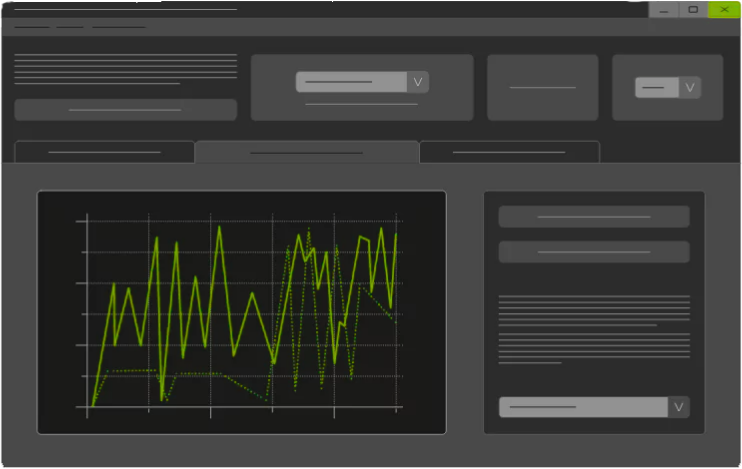
The Motor Manager is designed for all Romotion BLDC motors with a controller. Use the software to precisely parameterise your motor (e.g. speed limits, ramps, current limitation) and monitor live data directly on the PC. Connection is simple via the serial interface.
Our video tutorial guides you step by step through the initial setup (to the video).
To get your system up and running again quickly, we need a few technical details. Our team will check your details and send you a quote for a suitable replacement engine as soon as possible.
What you should have ready:
The article number: Can be found on the Rotek type plate (8 digits).
A photo: A picture of the nameplate helps us to immediately recognise configurations such as gear ratios or special shafts.
Important note: Our service is aimed exclusively at commercial customers (B2B). Unfortunately, sales to private individuals are not possible.
Here you will find answers to the most frequently asked questions about our engines, applications and services. If your question is not listed, our team will be happy to answer it personally at any time.
For which nominal voltages are the motors available?
In principle, windings are available for all voltages between 12 V~ and 3 x 500 V~. Windings for 230 V~, 115 V~, 24 V~, 3 x 400 V~ and 3 x 230 V (frequency converter operation) are standard.
What are the capacitors needed for?
Capacitors are only required for single-phase motors. The winding is divided into the main phase and the auxiliary phase. The main phase is connected directly to the mains voltage. In contrast, a capacitor is connected before the auxiliary phase in order to achieve the necessary phase shift for the rotating field. Three-phase motors do not require a capacitor.
How can the engine speed be changed?
The speed of synchronous motors depends solely on the mains frequency and not on the load or voltage. Using a frequency converter, the motors in the ROBASE series can be operated between 7-70 Hz (ROSYNC and ROSLYDE: 1-70 Hz). We recommend the motors of the ROSYNC and ROSLYDE series and the 6-pole motors of the ROBASE series for operation on the frequency converter.
Do I need a brake?
Thanks to the use of powerful permanent magnets, synchronous motors have a self-holding torque when de-energised. This means that our motors have no overrun and are ideal for reversing operation. If the application requires a higher self-holding torque, our 4-pole motors from the ROBASE series are particularly suitable.
Are the motors damaged in the event of a temporary blockage?
If the motor is blocked for a short time, there is no thermal damage to the winding. Nevertheless, blockages should be avoided as far as possible to prevent damage to the gearbox.
How are the drives protected against dust and water?
The standard DIN VDE 0530, EN 60529, Part 5 defines the degrees of protection for enclosures (does not apply to the output shaft) of rotating electrical machines. The degree of protection is indicated by the code letters IP and two code numbers. Our drives are supplied in IP40 as standard. The terminal box version is also available in protection class IP55 as an option.
Which operating modes are possible for the motors?
The motors are designed for continuous operation as standard. To achieve higher output power, the winding can also be reinforced. At the same time, the possible duty cycle is reduced. Windings for S2 and S3 operation are currently available. The duty cycle specified on the rating plate must be observed. Otherwise the motor will be destroyed by overheating. The motor can also be protected against burn-out with a thermal circuit breaker.
Can the drives also be operated at high or low ambient temperatures?
Our drives are designed for ambient temperatures from -25°C to +50°C, the planetary gearboxes for -10°C to +60°C. For other ambient temperatures, please enquire.
Is it a problem that the motor gets hot during operation?
The motors are designed according to insulation class F for a maximum winding temperature of 155°C at a maximum ambient temperature of 50°C. High temperatures can be reached on the surface of the housing during prolonged operation without damaging the motor. A wire resistant to temperatures of up to 180°C is used for the winding.
ATTENTION: For motors for short-time operation, the specified duty cycle must not be exceeded!
Can the synchronous motors also be operated as stepper motors?
Our synchronous motors can also be operated as stepper motors if the coils are wired differently. The 6-pole motors are particularly suitable due to their more favourable resonance behaviour.
Your question was not included?
Niklas
Martin
Robin
No problem - our support team will be happy to help you personally. Together we will find the right solution for your project.