

ROMOTION with
Ferrite magnets
Independent of rare earths
How much of the motor remains without neodymium? More than many people expect.
Quick check
Is ferrite suitable for your application?
Ferrite is suitable if
- Your drive is not operating at the limit of its rated torque
- Security of supply and costs are your top priorities
Neodymium remains the right choice when
- You need maximum performance in the smallest possible space
- Your application utilises the full rated torque
Not sure? Send us the torque, speed and duty cycle for your application.
We’ll tell you whether ferrite is sufficient.
Technical details
Ferrite vs. Neodymium
Rated data for continuous operation, 24 V
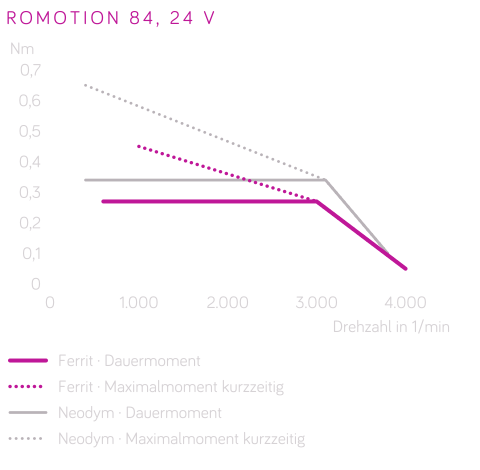
Catalogue data, recorded using the M52 electronics (more powerful versions to follow).
Conservative lower range values. Higher peaks are possible during short-term operation.
| data | ROMOTION 84 Neodymium | ROMOTION 84 Ferrite |
|---|---|---|
| Rated power | 110 W | 80 W |
| Nominal torque | 0.34 Nm | 0.26 Nm |
| Rated speed | 3100 rpm | 3100 rpm |
The ROMOTION 84 has around 24 % less torque. The rated speed and speed range remain the same.
All figures are given without a gearbox: at the output end, the difference can often be compensated for by the gear ratio.
Ferrite vs. Neodymium
Rated data for continuous operation, 24 V
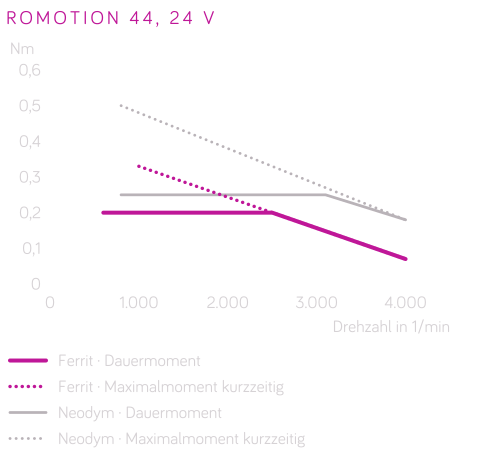
Catalogue data, recorded using the M52 electronics (more powerful versions to follow).
Conservative lower range values. Higher peaks are possible during short-term operation.
| data | ROMOTION 44 Neodymium | ROMOTION 44 Ferrite |
|---|---|---|
| Rated power | 80 W | 50 W |
| Nominal torque | 0.25 Nm | 0.14 Nm |
| Rated speed | 3100 rpm | 3100 rpm |
In the ROMOTION 44, the ferrite version delivers 0.14 instead of 0.25 Nm at the same rated speed. Suitable for continuous operation at low torque.
All figures are given without a gearbox: at the output end, the difference can often be compensated for by the gear ratio.
Where ferrite is suitable
Wherever the peak torque of a gear motor is not the decisive factor, ferrite is the lower-risk option and offers greater reliability of supply.
Typical areas of application:
- Conveyor belts and conveyor systems
- Screw conveyors in pellet-fired heating systems
- Rotor drive in heat exchangers
From the practice
Technical article in *Antriebstechnik* 6/2026
Independent of rare earths
Around 70 % of rare earths come from China. You can read about how we are making our drives independent of this supply in *antriebstechnik* 6/2026.
Source: TA-Kompakt No. 6, April 2026
ROMOTION Ferrite in the heat exchanger
ROMOTION 44 with ferrite magnets in the rotor drive of a heat exchanger. Successfully tested in-house, now undergoing trials at the customer’s site.
- Continuous operation at low speed thanks to a 50:1 reduction ratio
- Hard-wearing material in the first gear stage reduces running noise
- Ferrite instead of neodymium to ensure supply reliability for large quantities
FAQ
What you need to know before switching to ferrite. Our sales team is on hand to help with anything else you may need.
Can I convert an existing application to ferrite?
In many cases, yes. The design and connections remain the same. The key factor is whether your application can manage with the lower rated torque or whether this can be compensated for via the gear ratio. We’d be happy to check this for you.
Will the neodymium version remain in the range?
Yes. Depending on the application, you can decide whether to use the ROMOTION with ferrite or neodymium magnets.
Is the ferrite version also available in 48 V?
The 48 V version is currently under development. Please get in touch if you would like to include it in your project.
Why is ferrite more reliably available than neodymium?
Neodymium is one of the rare earth elements, around 70 % of which originate from China. Ferrite magnets are manufactured worldwide and are available independently of this supply chain.
Start your drive project now
Your contact persons

Niklas
Robin
Phil
We will assess your application and select the appropriate motor and gearbox.